Competitors
A Share-of-Voice leaderboard, trend, engine heatmap, and answer-gap matrix ranking your brand against the competitors you track, plus auto-discovery of rivals you don't.
Visibility tells you how you are doing. Competitors tells you how you are doing against the companies you are up against.
What it does
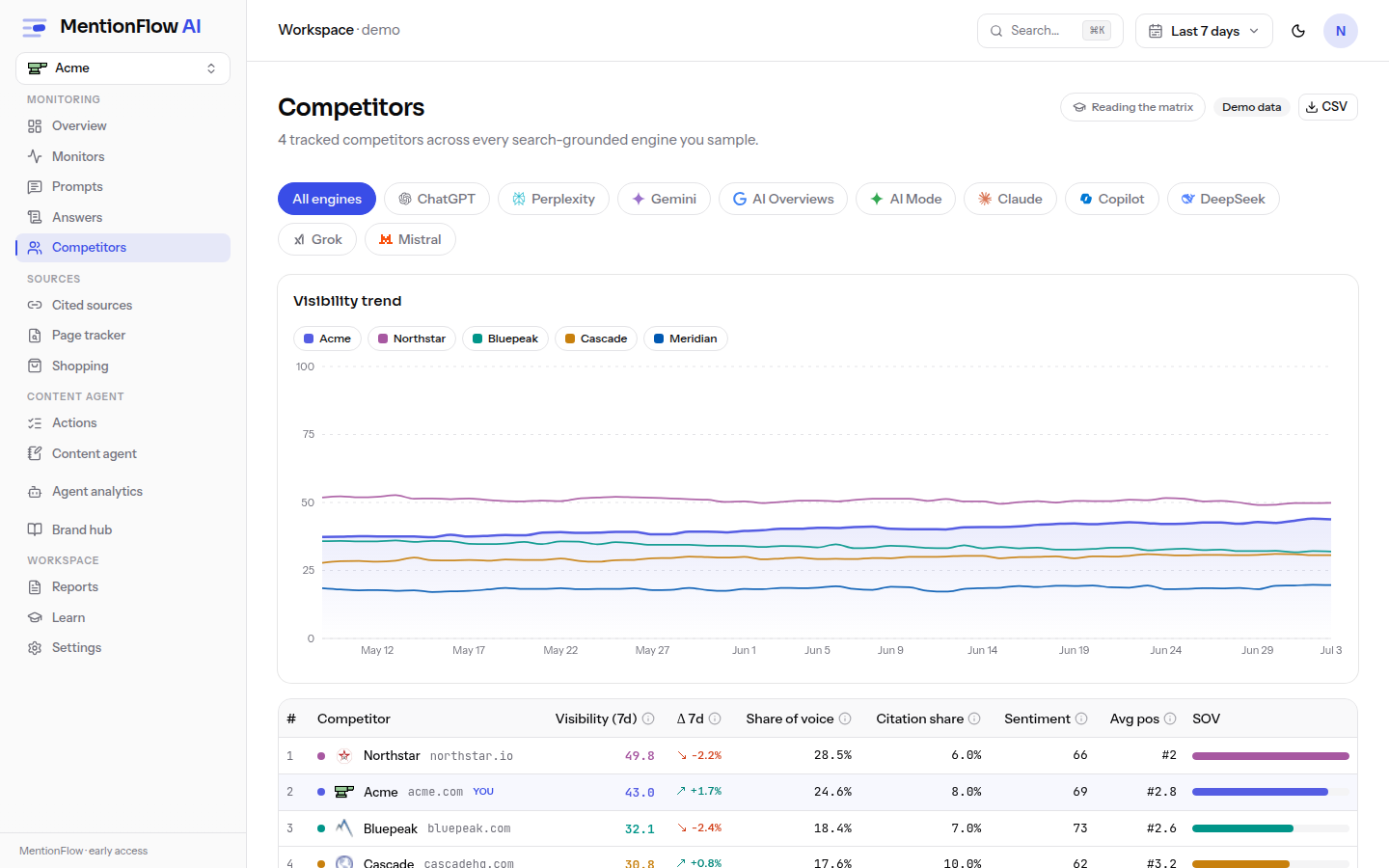
This page answers "who is winning the answer, and where am I losing it?" It sorts your brand and its competitors by Share of Voice, shows how that split moves over time and across engines, and turns the prompts where a rival beats you into a gap list you can act on. Rivals you never told it about are surfaced automatically when they keep turning up in your answers.
How to use it
- Filter by engine. The All engines dropdown is a checkbox multi-select. Tick two or three engines to compare specific models. Every panel narrows to the ticked set, including the per-engine heatmap's columns.
- Read the leaderboard. It sorts by Share of Voice across your brand and the competitors you track.
- Grow the set. Suggested competitors can be Tracked or Dismissed-forever.
- Work the gaps. The answer-gap matrix links each gap to an action or a content brief, so a gap becomes a task rather than a chart.
- Manage the set. The manage panel notes that changes apply from the next collection cycle. The competitor set edits forward, not backward.
- Fix attribution. If engines call a competitor by another name, add it as an alias in Matching rules so its mentions are counted correctly.
How it's computed
Share of Voice's denominator is the sum, across the whole tracked set, of per-entity run-presence counts: runs that mention an entity at least once. It is a zero-sum split. Everyone's share adds up to the whole of that set. Brands the answers name that you don't track are outside the denominator. See what SOV does not measure and the Discovered tab below.
Every leaderboard metric, Share of Voice included, blends only the eight search-grounded engines. That is the same scope the API computes from, so the page and GET /api/v1/competitors can never disagree. Filtering to an explicit engine set, one engine or several, skips blending and shows exactly those engines honestly, model-knowledge engines included when you tick them. The data-honesty page names every place denominators differ on purpose.
The rest of the math:
- Citation Share, Sentiment, and Average Position show em-dashes when null. That means nothing measured yet, not a zero.
- Discovery surfaces untracked names appearing in at least two answers (top 8) on this page. The Discovered tab shows the whole field.
- A gap is flagged when a prompt has at least three runs, your presence is below 0.2, and some rival's presence is at least 0.6. That is a clear, repeatable miss rather than a one-off.
The Discovered tab
The leaderboard measures the set you chose. Discovered measures what you didn't. It lists every brand your answers have named that this project doesn't track, ranked by mention count over every completed answer collected: all prompts, all engines. It is a worklist, not a windowed metric. Track a name in one click, or dismiss it. A dismissal is restorable from the same page.
The tab also states the shape of the field: how many mentions belong to you, to a tracked competitor, and to nobody you track. Share of Voice never divides by that last group. In your tracked set turns that into one number: the share of every named mention that SOV's denominator can even see.
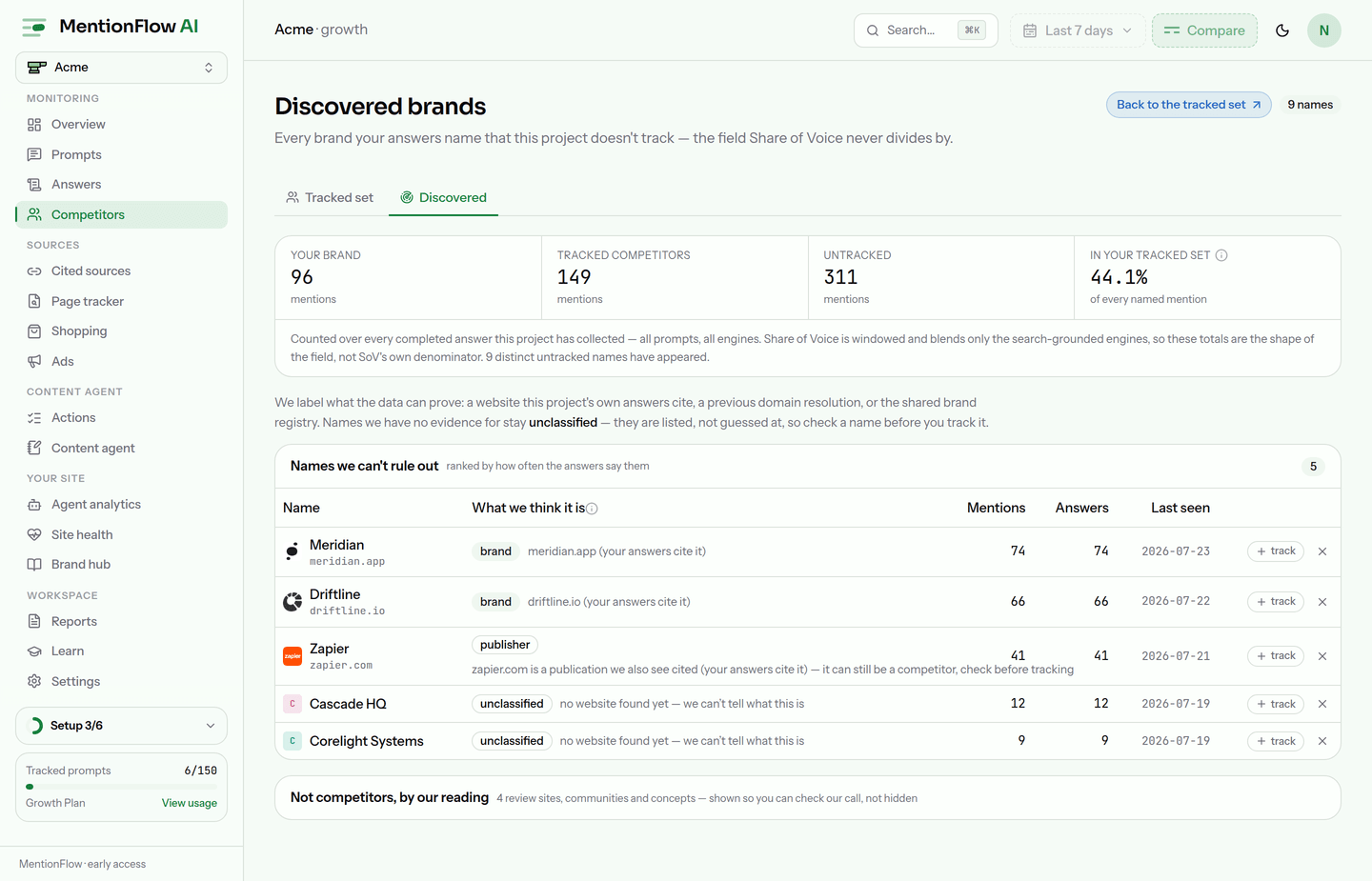
Sample project, seeded for this screenshot. Unlike the other screenshots in these docs this page has no demo mode. It reads the answers a project has actually collected, so it stays empty until yours has run a cycle.
Each row carries what we can prove about the name, from evidence we already hold: a website this project's own answers cite, a previous domain resolution, or the shared brand registry. We classify it with the same curated source-class rules the citation classifier uses. Names our evidence reads as review sites, communities or generic concepts are listed separately, not offered as competitors. Names we have no evidence for are labelled unclassified, never guessed into a "brand". Check one before you track it.
The rules are strict on purpose, so expect unclassified rows on a healthy account. A name only picks up a website from your own citations when it is a single word whose exact registrable label matches a domain your answers cite. "Asana" matches asana.com. "Click Up" is two words, so it does not match clickup.com, and we would rather say so than guess. Names nobody has evidence for are resolved a few at a time in the background, so the head of the list fills in as you read it and the long tail stays honestly unlabelled.
Limits
- A project tracks up to 50 competitors. This is a capacity limit, not a plan tier. No plan meters competitors. At the limit, tracking refuses with the count rather than failing silently. Untrack one to make room.
- A project can hold up to 500 dismissed names.
- The Discovered table renders the top 100 names by mention count. When the field is deeper, the page says so ("Showing the top 100 of N") rather than quietly dropping the tail.
- CSV export is available.
Related
- Matching rules: competitor aliases and custom patterns that decide what counts as a mention.
- Sources: where competitors are cited.
- Actions: the tasks a gap links to.
- Share of Voice: the leaderboard's metric.
- Presence rate: the presence figure behind gap flags.
- API / MCP:
GET /api/v1/competitors(each row includes your own brand's row, flaggedis_brand) and thelist_competitorsMCP tool.