Content
Where your site covers the questions you track and where it doesn't, plus drafts and briefs written from your own facts and followed for the citations they win.
The way to climb in AI answers is to publish the content assistants want to cite. But which content? Content answers that.
What it does
It shows where your published content covers the questions you track, and where it doesn't. Then it helps you fill the gaps with drafts and briefs written against your own facts. Then it follows a published article to see whether it later earns citations. It is the loop from "we're missing this" to "we published it" to "it's working."
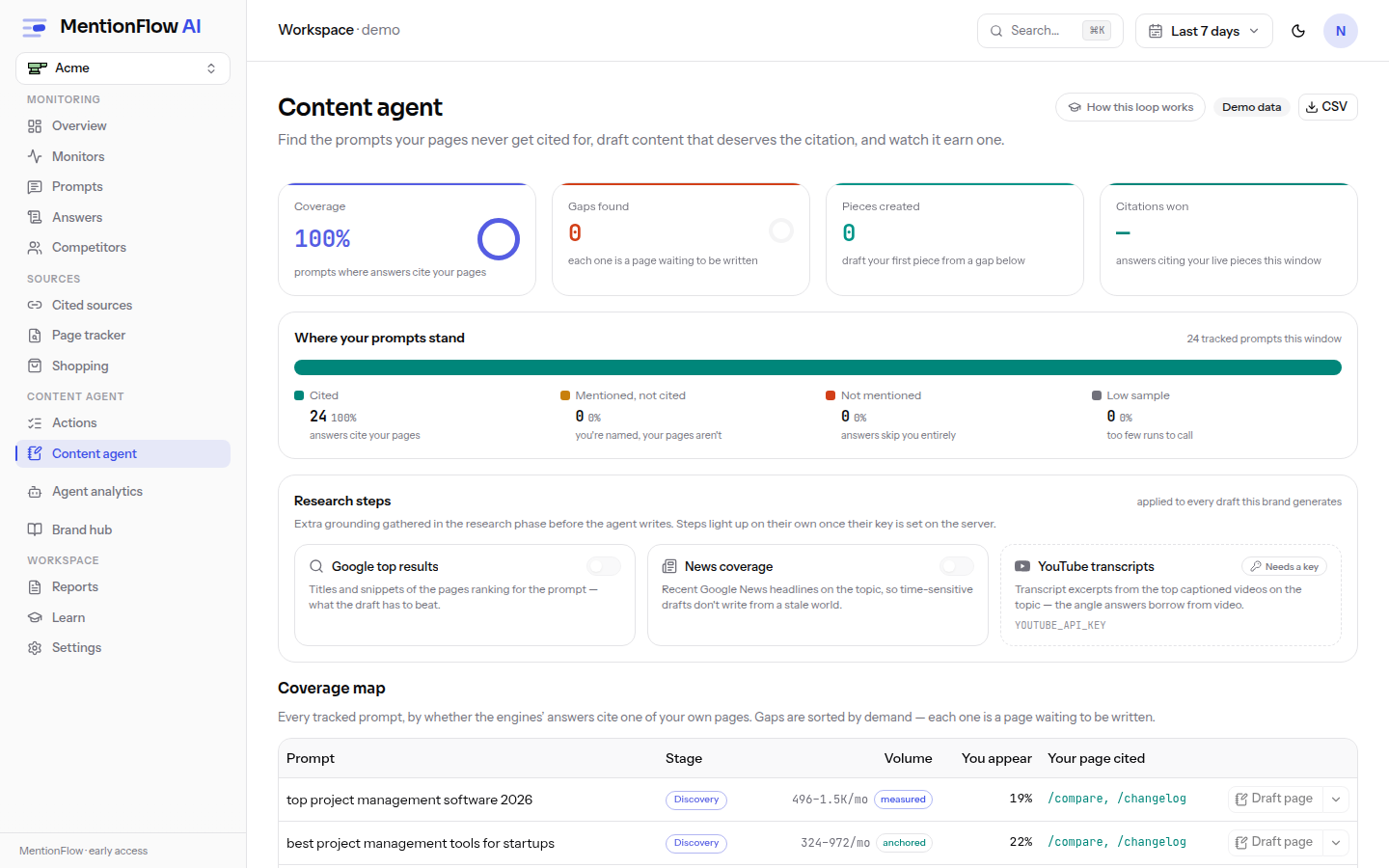
The four tabs
The agent splits across four subpages that share one header and tab bar. The sidebar and every in-app pointer land on Overview, and every number there links to the tab that holds its rows.
- Overview: where the loop stands. The four tiles (Coverage, Gaps found, Articles, Citations won this window), the "where your prompts stand" distribution, and a grounding strip that links out to your fact sheet and sources.
- Coverage: the two questions behind the score. The coverage map shows every tracked prompt, by whether the engines' answers cite one of your own pages. Site coverage shows whether your site even has a page for the prompt yet. Filters ride the URL (
?filter=), so any filtered view (gaps, cited, low-sample) is a link you can share. The chips, tiles and filtered list all count through one shared definition, so they can't disagree. - Articles: everything the agent has produced, tracked queued, then drafting, then live, and what each live article has earned.
?filter=citedis the receipts view behind the Overview's Citations-won tile. - Research: the per-brand research steps the agent runs before it writes, described below.
How to use it
- The coverage tile is covered divided by prompts with at least 3 runs. Null renders as an em-dash. Low-sample prompts read "too few runs to call" and stay out of the denominator entirely.
- Drafts are written by a language model with deterministic JSON-LD, and are metered per UTC month. The meter is checked before the paid model call. See Plans and quotas.
- Research steps run per brand. Before writing, the agent can also gather Google top results, news coverage, and YouTube transcript excerpts. Each step turns itself on only when its server key is set: DataForSEO for SERP and news,
YOUTUBE_API_KEYfor transcripts. A keyless step reads "Needs a key" and never runs silently. The article page lists exactly which inputs grounded each draft. A count of 0 means the step ran and found nothing. - Editing in place: a draft is editable on its page. Saving a change marks the article Edited by hand. From then on the words are yours, and nothing regenerates over them without an explicit action.
- Taking an article Live requires a published path. That path is the join key that lets MentionFlow track whether the article later earns citations.
- Briefs are available on every plan. The only content gate is the monthly draft meter.
How it's computed
Citations-won counts only live articles: content you have published and marked Live. The collection cycle records the daily trail, and that trail outlives the dashboard window. The article page charts every calendar day since tracking began. A day the cycle didn't run is a gap, not a zero. A stored 0 always means runs happened and the path went uncited.
Site coverage picks the single nearest embedded page per prompt with one database query, then buckets the similarity: excellent at 0.50 or above, good at 0.42 or above, medium at 0.34 or above. A prompt with fewer than three runs is held out of the coverage denominator, so coverage is never computed on a sample too small to trust. See data honesty.
Limits
Draft generation draws from your monthly draft allowance. See Plans and quotas. Taking an article Live requires a published URL. Without a path there is nothing to join citations against.
Related
- Actions: where content briefs are launched from a recommendation.
- Brand and knowledge: the ground truth the draft agent writes from.
- Plans and quotas: the monthly draft meter.